Wednesday, November 28, 2012

A Guide to Road Tripping in Britain

A short while ago, I wrote about rail travel in Britain and how travelling by train is my favourite mode of travel.  I guess I made it seem like travelling by car is less than ideal but there are two important aspects of car travel that absolutely trump rail travel: time and freedom. 

When you go on road trips, you have the time to lie in bed a little bit late one morning and there is no reason why you can’t spend that little while longer in a coffee shop or museum.  You have the freedom to choose the scenic route, you can stop to admire breathtaking scenery and you have significantly less chance of being thrown out of a moving carriage for singing at the top of your voice.

Road trips are about much more than just traveling between two points, they are about the journey, and road trips are as much fun to plan as they are to experience.  Many of the recent trips we’ve taken have been to specific destinations for example, Snowdonia in Wales and Windermere in Cumbria but I’d like to tell you about some of the best road trips I’ve undertaken in Britain and one that I have begun to plan.

England’s Ancient Heritage

London – Stonehenge – Bristol – Bath – Oxford – London

Our first road trip took us through thousands of years of English history from the ancient standing stones of Stonehenge to the remains of the Roman baths in Bath and finally on to Oxford.  This road trip took us two nights / three days but it would be really easy to add on another day or two if you wanted to extend your trip further west.

Stonehenge - main circle

Our first stop was Stonehenge.  Unless you’re there for the summer or winter solstice celebrations, there isn’t much point in hanging about more than an hour or so and so we headed off to spend the night in Bristol.

-> Detour: At this point it would be really easy to head north to Gloucestershire where you could spend the next day exploring the Forest of Dean and old town Gloucester. Alternatively, you could head further west and spend a day in Cardiff.

Early the next morning, we drove to Bath where we spent the day exploring the old town and the fabulous Roman Baths.  After Bath, we drove on to Oxford and spent the next day on a walking tour of the old colleges before returning home again that evening.

Northern History and Intrigue

London – Warwick – Liverpool – Manchester – York – St Albans - London

On our second English road trip, we stuck to our historic theme but this time delved into the more modern histories of Liverpool and Manchester, contrasted with the medieval histories of Warwick and York.  This road trip was slightly longer at four nights / five days. 

Leaving from London, we spent our first day in Warwick exploring the fabulous exhibits at Warwick Castle.  We then drove up to Liverpool, where we spent the night, and we spent the next day exploring the Pier Head, Albert Dock and tracing the Beatles’ footsteps. 

-> Detour: If you’d like to add an extra day into your itinerary, it would be a good idea at this point to head off to the fabulous walled city of Chester or you can also spent a day in Blackpool, a seaside resort town which I love but which most people say is a bit gaudy.

The Royal Liver Building as seen over the Cunard Building

Our next destination was Manchester, the home of Manchester United, where we spent the night.  We spent the next day and night taking advantage of Manchester’s great shopping opportunities and fabulous pubs, with a quick visit to Old Trafford. 

Bright and early the next morning, we headed off to York where we discovered York Minster, the Shambles, Clifford’s Tower and the York Castle Museum.  The next morning we headed home to London but made sure we stopped off at the Roman Ruins in St Albans on the way.

Breathtaking Vistas in the Scotland Lowlands

Edinburgh – Crieff – Aberfeldy – Pitlochry – Perth - Edinburgh

We spent a week in the Scottish Lowlands in 2010 and took several day trips from our base in Loch Monzievaird.  I was absolutely enchanted by Scotland and was especially taken with the buildings in their creepy, Scottish Baronial style.

This trip wouldn’t have been possible without a car though, so I am going to suggest a four night / five day road trip of the area (with a bonus photo!)

The View From Edinburgh Castle

On the first day, arrive in Edinburgh and spend the day exploring Edinburgh Castle, the Old Town and Princes Street Gardens.  From Edinburgh, drive to the market town of Crieff and spend the next morning exploring the old town, Drummond Castle and Gardens and The Famous Grouse Experience.

Drive up to Aberfeldy where you’ll spend your second night.  The next morning, you can explore the old town, visit the Watermill bookshop and check to see how the rebuilding works are going at the Art Deco cinema The Birks. 

Crieff (8)

After lunch, you’ll then head off to Pitlochry, the home of Heathergems and Pitlochry Festival Theatre, where you’ll spend your third night.  Pitlochry is especially popular among walkers and hikers so do keep that in mind if you arrive in season. It might be worth spending an extra night in Pithlochry if that interests you.

The next morning, you’ll drive down to Perth where you’ll visit Lochleven Castle and The Scottish Deer Centre.  You’ll spend your final evening in Perth before returning to Edinburgh the next morning.

A Short Tour of East Anglia

London – Bury St Edmunds – Norwich – Cambridge – London

Once again, we spent a week in Swilland Mill when we took our tour of East Anglia last December, but our adventures wouldn’t have been possible without a car.  I’m going to suggest a short three day / two night road trip.

From London, drive up to Bury St Edmunds where you’ll spend the day exploring the ruins of the Abbey of St Edmund and the present day St Edmundsbury Cathedral.  Spend the night in town, or perhaps drive through to one of the seaside towns of Aldeburgh, Southwold or Lowestoft. 

Spend your second day in Norwich and be sure to check out Norwich Castle, the Royal Arcade, the market and the Church of St Peter Mancroft.  Norwich really comes alive at night, so I’d definitely recommend you spend your second night in or near to the city.

Kings College Cambridge

You’ll return to London the next morning but do be sure to stop by the ancient university town of Cambridge on your way back.  Take a long stroll around the colleges and down the canals and perhaps even indulge in a boat ride if weather permits. 

From Train Windows to Reality

London – Lincoln – Whitby – Newcastle – York – Nottingham – London

I’m pretty good at turning road trip plans into reality but there is one road trip I’ve been planning since 2010 which is still but a dream.  The problem is that there is so much to see and so far to travel and while I’d like to think this is possible in five days / four nights, that might prove to be too tiring.  This is a rough idea of the next road trip that I am planning:

On the first day, travel up to Lincoln where you can admire Lincoln Cathedral and also explore some of the abbeys and monasteries lying in ruin since the Dissolution of the Monasteries.

The Ruins of Whitby Abbey

Travel up to Whitby the next day where you can explore one of the most famous ruins of all, Whitby Abbey.  Be sure to stop off in town for some famous fish and chips too or indulge in some Gothic or Bram Stoker-themed adventures.

The third day would be spent in Newcastle, a town I have wanted to visit ever since passing through there on a train.  The fourth day would be spent in York, exploring some of the Viking activities that we missed during our first visit and the last day would be spent following in Robin Hood’s footsteps in Nottingham.

What do you think? Too ambitious?

I hope that you find these road trips useful in planning your own around Britain. Personally, I can’t get enough of the history, architecture and countryside on this island.  Finally, I bring you some valuable tips if you are considering taking a road trip.

Five Tips for Road Tripping in Britain

Plan ahead but take it easy. Do plan your trips in advance to ensure that you make the most of your routes and don’t miss out on any attractions.  Conversely, don’t be afraid to stop off somewhere unexpected or to take it a little easier if you’re beginning to feel fatigued.

No room at the inn. Britain is not like the continent and you might run into trouble if you don’t book your rooms ahead.  Not only that, but you can lose out on some fantastic online or advance deals if you book ahead. We alternate between cosy country inns and the unbeatable £29 deal from Premier Inn.

Definitely learn the rules of the road. South Africans, New Zealanders and Australians can drive on their existing license for up to a year, whereupon they can exchange it for a British license.  The problem is that the rules of the road can be pretty different.  For example, speed limits are really clearly marked on all roads in South Africa but in the UK, you’re expected to remember what the standard speed limit is on a country road, a dual carriage way or the highway. Really, learn the rules of the road before you get behind the wheel!

You really don’t need to own a car. It is really easy to hire a car in the UK and it doesn’t have to be expensive either.  We’ve used Enterprise before when we’ve travelled to Liverpool and we also hire a van from them every time we move house. It is at least four of us on our road trips so the cost of car hire is far less expensive than individual train tickets for those journeys.

Satellite navigation is your best friend. I can’t stress this last point enough. In addition to the road trips listed above, we’ve visited Wales, Cumbria, Isle of Wight and even France, and we’ve also undertaken countless journeys to visit family in Liverpool and Manchester. We use a Tom Tom and we ensure that we update it before each journey and we also subscribe to live traffic updates. Beg, borrow or steal a SatNav if you have to, even use your smart phone or Google Maps, but don’t try navigate a journey in Britain without these modern conveniences!

Do you have any road trip ideas? Be sure to share them below so that other people can follow your routes.

SHARE:

Saturday, March 14, 2009

Road Trip (North): York - Shambles and about town

Part 1 - Churches ¦ Part 2 - York Minster and surrounds

York is such an interesting town with amazing architecture and a rich cultural heritage. I loved that the architectural styles span every single era dating back hundreds of years.

The Minster School York Minster Conference & Banqueting Centre
The Minster School and York Minster Conference and Banqueting Centre

We passed The Snickleway Inn which is said to be the most haunted pub in England. We didn't go in which was a shame because I love ghost stories! There are apparently five spirits haunting the inn and they even have the ghost of a small girl! How exciting (this from a girl who is still scared of the dark and who is, in reality, terrified of ghosts!)

The part my mum-in-law was most looking forward to was the Shambles. This is a tiny little street that looks almost like an alley way. The buildings almost touch!!

I promise we didn't actually know the couple who were posing so nicely in the middle of that picture! What a pretty, quaint little street.

River Ouse Merchant Adventurer's Hall
The River Ouse and The Merchant Adventurer's Hall

That beautiful building is the "finest surviving medieval guild hall in Great Britain". I think it was so pretty - click on the picture to see a bigger resolution.

Would you believe this photo was only taken at 2pm?? It looks like the sun was about to set. Thank goodness summer is on the way! Clifford's Tower is part of all that remains of York Castle.

The last stop in our grand tour of York was awesome York Castle Museum. This is a mammoth museum complex and like many of the museums and places we visited on our road trip, it really does deserve a whole day dedicated to it!

Retro Victorian village
Fashion Museum Toy Museum
Fashion Museum The Sixties!
Retro, Victorian Village, Fashion Museum, Toy Museum and The Sixties

The museum had a retro section that went through appliances from the past 60 years and it also had model living rooms and kitchens dating back over 200 years. It was fabulous! There was a full Victorian village complete with sweet shops, a police station and chemist. There was the most amazing fashion museum with shoes and clothing dating back hundreds of years. The lighting was very muted in that section of the museum to protect the aging fabrics. There was a section the famous highwayman Dick Turpin and the cells he was kept in (unfortunately, I didn't get any decent photos there). Finally, there was a great Sixties section and I loved that so much as I love all things sixties.

And so our whirlwind trip of York was over and that was also the last major stop on our road trip. We saw so many incredible things but in the end it was nice to get back home. There is no place like home!

SHARE:

Thursday, February 26, 2009

Road Trip (North): York - Minster and surrounds

Part 1 - Churches

Alongside Cologne Cathedral, York Minster is the largest gothic cathedral in Northern Europe (some say it is the biggest).  While it is known that earlier versions of the Minster existed, there is no longer an archaeological evidence for these.  The building in its current form dates back to 1100 though, which is pretty old! 

York Minster York Minster York Minster

York really was a festive little town and I loved the atmosphere in many of the places we visited on our road trip.  Many times in York, Warwick and Bath there was an air of festivity with live music and stalls and fun fairs.

This man was playing "Hallelujah" on his piano.  I couldn't really say whether it was the Leonard Cohen or Alexandra Burke version but seeing as I spent tons of money voting for Alex to win, I'll just say it was hers.

Anglo-Boer War memorial

There was a memorial to those lost fighting the Anglo-Boer war in South Africa between 1899 and 1902.  Even though I am of English decent, I took a moment to remember the many Afrikaans people who perished both in the fighting and in the concentration camps too.  It is an often overlooked fact that the British invented concentration camps.

War memorials are very sad to me actually.  I think war is such a senseless thing and there is rarely a true right or wrong side, just thousands of needless casualties.

I'd better steer off the politics before I lose all of my readers!  (Or the ones Blogger and Google Connect did not drop, that is).

Right across the road from York Minster is another church, St Michael Le Belfry.

St Michael Le Belfry St Michael Le Belfry

St Michael's is an Anglican church and was built between 1525 and 1537 during King Henry VIII's break with Rome.  How does one describe Henry's architecture in the way that we describe "Elizabethan", "Victorian" or "Georgian" styles?  This style is not my favourite, anyway.

Bridal partyOn our way back into the town, we spotted this bridal party making their way into the York Minster.  Can you imagine getting married in such a place???  Hardly the outdoor, poolside, South African bush experience I had!  

They must have been freezing.  As it was, we were too cold to stick around and wait for the bride!!

SHARE:

Monday, February 16, 2009

Road Trip (North): York - Churches

The final destination on our road trip around England was York.  We were staying a couple of days at my friend Nina's house in Bolton and so we were able to spend almost a whole day in York without the worry of checking into and out of hotels and spending hours travelling between cities.

Incidentally, we were meant to go to St Albans on the way home to London when we left the next day.  Unfortunately, Mandy only managed to make it out of bed after 10am that day so that idea fell by the wayside.

I knew nothing at all about York before we went but it was the one destination that my mum-in-law had requested before they came over from South Africa.  York is an absolutely charming and pretty little town located four hours north of London.  It has a really rich history dating back to Roman and Viking times and it is a walled city.

York is full of churches.  This old gem dates back to the 14th century and is named Church of All Saints Pavement because it stands on on of the earliest paved streets in York.

I really loved this red brick building but I couldn't find any details about it online.  This is an exquisite exam of Victorian red brick architecture - look at that detail!

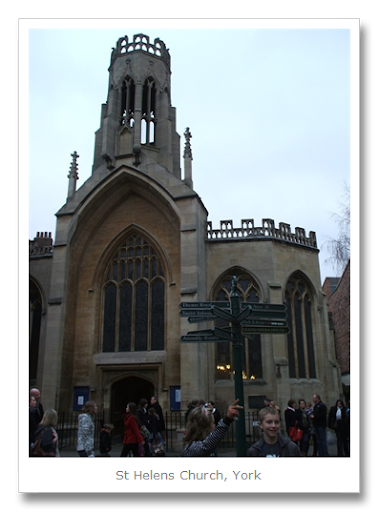
St Helens Church is an incredibly old church.  From their website, "the oldest datable feature in the church is the mid twelfth century font, and it is likely that the church was rebuilt in stone at that time or earlier".

This spectacular example of Victorian architecture is St Wilfrid's Catholic Church which was completed in 1864.  How beautiful is it?

Townhouses York Minster

I loved the terraced housing in the picture above.  It reminded me of all of the romantic notions I had about Victorian England and the world of Peter Pan and Mary Poppins.

That is York Minster you can see in the distance there but that deserves its own post!

SHARE:

Wednesday, February 11, 2009

Road Trip (North): Liverpool part 4

Part 1 ¦ Part 2 ¦ Part 3

I have to be honest.  I'll be happy once I've finished uploading all the pictures and stories from our road trip in December.  We just saw so many wonderful things and I want to remember it all!

The last stop on our trip to Liverpool was the Merseyside Maritime Museum.  This is a massive museum actually comprising several different exhibitions and attractions and if you were spending more than a few hours in Liverpool, then I would recommend that you set aside a whole morning here.

First things first - it was a cold day that day and we had been traipsing around for hours.  So our first stop was for some rich hot chocolate with cream.  Yum!

We then went to see the Titanic, Lusitania and Forgotten Empress exhibition.  This was really, really interesting. 

Figurehead from HMS Hastings  Items salvaged from the wreck of the Titanic Apron worn by Titanic survivor
Figurehead from HMS Hastings / items salvaged from the Titanic / apron worn by Titanic survivor
Click pictures for bigger photos

I stood looking at that apron for a really long time. A person had been wearing that apron and had escaped the sinking Titanic and was taken to safety. I found it really touching in a way I can't explain. 1,517 people died on the Titanic as there were not enough lifeboats. More men died as women and chldren were taken to safety first. The band continued to play music as the ship went down and none of them survived. The captain of the Titanic went down with his ship. Most of the people that died in the Titanic were third class passengers and staff. There were 706 survivors.

I knew some of these stories before but I hadn't previously known anything about the RMS Lusitania. This story really shocked me. This luxury liner was torpedoed by a German U-Boat in 1915 during World War I.  More passengers died in this disaster than in the Titanic because so many of the passengers were in their rooms or were hit directly by the torpedo.  1,198 people died that day and over a half of those were children. 

The next part of the complex that I visited was the International Slavery Museum.

This is a rich and complex exhibition detailing the slave trade and the history of racial oppression round the world.  There is a lot of material on modern day slavery and human trafficking as well.  I didn't take any photos during the exhibition (except for the above) but I spent a lot of time there absorbing the wealth of information.   I do think the ISM is badly placed in the Merseyside Maritime Museum as I believe it should be a destination in and of itself but I imagine that this is one way of making sure that people visit and that they get people through the door.

The last part we looked at before we went was the Seized! exhibition which is a fantastic exhibition about the type of items that people try to import into the country.  Very interesting!

It was getting late by then and suddenly it was time to go.  There is so much we didn't get to see including the Tate Liverpool and the bombed out Church of St Luke.

Swanky Apartments in Liverpool  The Pillar of Friendship Installation in Liverpool One 
Dockside living / The Pillar of Friendship installation
Click pictures for bigger photos

We did get to walk through Liverpool One on the way back to the car.  This is a trendy new dockside-living and shopping complex.  We dreamt of one day living in those swanky apartments (one day after The Puppies have gone on to the big dog kennel in the sky) and we admired the Pillar of Friendship installation on Paradise Street.

All in all, it was an awesome day and I can't wait to go back to my beloved Liverpool sometime in the near future.

SHARE:

Sunday, February 08, 2009

Road Trip (North): Liverpool part 3

Part 1 ¦ Part 2

Next on our tour of Liverpool was the Pier Head. The Pier Head is definitely my favourite part of Liverpool and it has some of the best architecture in the world (once again, my fascination with old buildings comes up. It's not my fault I spent much of my working career as a property manager housed in a listed building, is it?)

The Pier Head is a small strip of land with three magnificent old buildings facing out over the Mersey River. This is where you will catch the ferry made famous by the Gerry and the Pacemakers song, Ferry Across the Mersey.

Liverpool Pier Head  Liverpool Pier Head 

Most days we would catch the Merseyrail under the Mersey and come out at Hamilton Square, then we would catch the ferry back. On this particular day though, it was very cold and we had loads to do so we settled for lots of photos instead!

The Royal Liver Building & the Cunard Building   The Port of Liverpool Building
The Royal Liver Building, The Cunard Building and the magnificent Port of Liverpool Building
(click on the pictures for larger shots)

The Royal Liver Building was built between 1908 and 1911. "Liver" in this instance is pronounced "laiver". It houses two Liver birds on top of the buildings. These are the fabled birds that look after the city of Liverpool and the story goes that if they were ever to fly away, then the city of Liverpool would cease to exist. They are not the only Liver birds in Liverpool but they are the biggest and most famous. The two Liver birds on the Royal Liver Building face in opposite directions - one of the birds faces inwards towards the city of Liverpool and the other faces the Mersey River.

Many of you will know the Liver birds from the Liverpool Football Club crest of course. I would post a picture but that would just ruin my blog. (I'm a proud Everton supporter).

The Cunard Building was built between 1914 and 1917 as the headquarters for the Cunard Line, the shipping company that owned the Lusitania. I'll talk about the Lusitania more in my next post about our visit to the Merseyside Maritime Museum. My brother worked on the fourth floor of the Cunard Building from 2006 to 2008 when I convinced him to rather come and live in London with us. Looks like that worked out for him as he is earning twice as much now than he was in Liverpool!!! In any event, I would absolutely love to work in an old building like the Cunard Building and I think he is very fortunate. He says they often popped over to the Royal Liver Building for lunch in one of the restaurants. Can you imagine that?

The Port of Liverpool Building was built between 1903 and 1907 and was designed by Sir Arnold Thornley following an architectural competition in 1901. It is an absolutely exquisite building with the most intricate details and finishings. Actually, after reading the details about it on the Liverpool World Heritage website, I now know that I have to go inside the building if I truly want to appreciate it.

During the Blitz in 1941, a bomb exploded in the basement of the Port of Liverpool Building. The cost of the restoration project that began after the war far exceeded the original cost of constructing the building!

Merchant Navy War Memorials Liverpool Pier Head   Merchant Navy War Memorials Liverpool Pier Head

Liverpool was so badly affected in the Blitz of World War II and these memorials to sailors from the Merchant Navy are also located on the Pier Head.

The Buildings of Liverpool Pier Head   The art deco George's Dock Ventilation
The Buildings of the Pier Head and the art deco George's Dock Ventilation with the rear of the Port of Liverpool Building and the Royal Liver Building in view
(click on the pictures for larger shots)

Finally we tear ourselves away from the old Pier Head and walk on up to the Albert Dock. On the way we are reminded of just how much this magical city has to offer.

SHARE:
© 2008 - Mandy Southgate | Emm in London

This site uses cookies from Google to deliver its services - Click here for information.