Last Saturday, we planned the quintessential London day. We took a stroll down Oxford Street, had lunch in Soho and spent an afternoon watching Just for One Day: The Live Aid Musical at the Shaftesbury Theatre.
It was a lovely day, the perfect day for wandering about, and it was thankfully cooler than it had been earlier in the summer.
My love for opera is quite new. I was always in love with the idea of opera, inspired by countless films in which the characters sat in the balcony at the opera and silently wept, but my first night out at the opera was last year. Of course, that was all it took. Seeing Puccini's La Bohème at the ENO was incredibly moving and I knew then that I had become a lifelong fan.
Naturally I was delighted when the ENO contacted me to ask if I would like to see Puccini’s Tosca, on at the ENO until December. I said yes straight away and was thus treated to an evening of tragedy, colourful costumes and breathtaking sets.
The Story
Tosca is set in Rome during the time of Napoleon's invasion of Italy. It is the story of betrayal, political sabotage and a politician who will stop at nothing to get what he wants. It is also the story of a love that knows no parallel.
Tosca is an opera singer known across all of Rome for her talent and beauty. She is deeply in love with the artist Cavaradossi but her jealousy stands ever at the fringe of their relationship. When Angelotti, an escaped political prisoner, flees to the Sant'Andrea della Valle in Rome, Cavaradossi agrees to hide him but it is a decision that will change his life forever. Suddenly, sadistic police chief Scarpia has his sights on Cavaradossi but it is Tosca who he really wants.
What follows is a story of unbearable treachery and murder, sweetened only by a love that knows no bounds.
The Production
Tosca at the ENO is an extravaganza of colour, sound and incredible set design. It really was a feast for all of the senses and made for a highly entertaining evening.
Soprano Keri Alkema is Tosca and she captures the audience’s imagination as the passionate and playful opera singer. Her lover Cavaradossi is played by Gwyn Hughes Jones, notable for his dedication to Tosca and his defiance in the face of adversity.
Craig Colclough plays Scarpia and he was utterly convincing and quite frightening as the nasty and dastardly villain. He was thoroughly horrible.
The dramatic storyline is accompanied by Puccini’s powerful score and the orchestra was conducted by noted Puccini specialist Oleg Caetani.
The ENO
If you’ve ever wanted to see the opera but aren’t sure where to start, then the English National Opera is the place to start. Their aim is to bring opera to the masses and they do everything in their power to ensure that people without an in-depth knowledge of foreign languages or famous plays can enjoy a night out at the opera. The performances are in English with surtitles above the stage to assist the audience in following the story. I’d also highly recommend the ENO programmes too, they are full of information about the writers, the social and political environment in which the operas were drafted and notable performances over the years.
Opera Undressed
The ENO have also gone one step further with their brand new Opera Undressed events. If you sign up for a free Opera Undressed membership, you can experience your first opera for just £20 plus booking fee and also attend a pre-performance talk about the production plus a post-show party with the cast. Not only is this incredible value but we found the pre-performance talk to be especially informative and interesting.
The Trailer
Tosca at the ENO is on until 3 December 2016 and is highly recommended.
ENO London Coliseum St Martin’s Lane London WC2N 4ES
I’d like to thank the ENO for inviting me along to the Opera Undressed event for Tosca at the London Coliseum.
It is one of the greatest love stories of all time. One Christmas Eve in Paris, young bohemian Rodolfo receives a knock on the door of his tiny, freezing apartment. It is his neighbour Mimi, weak with cold and hunger. Within moments of meeting, Mimi and Rodolfo realise that they are falling in love but can their love survive the treacherous Parisian winter?
Starring Corinne Winters as Mimi and American tenor Zach Borichevsky as Rodolfo, Puccini’s La bohème is showing at the London Coliseum, home of English National Opera, until 26 November 2015.
The Emotion
La bohème is, in a word, unforgettable. From the moment the performance began, I was mesmerised by the beauty and energy on the stage below. It is one thing to hear recordings of opera or see it on screen but to hear that medley of soprano, tenor, baritone and base voices live is incredible.
I was quite unprepared for the depth of emotion that I would feel during the performance. I knew that opera could be an emotional experience and this was one of the reasons that I had wanted to visit for so long. In my mind, I recalled countless films where characters sat in the gallery, transfixed by the performance below, a tear rolling down one cheek.
I just didn’t realise it would happen to me.
There I was, beaming with joy as the first act opened, smiling like a child at Christmas. Towards the end of the first act, when Rodolfo and Mimi first mention the word ‘love’, I felt a surge of emotion, a lump in my throat and goose bumps all over my body. I looked around and was pleased to see that I was not the only one touched by the performance. I won’t give the story away but I’m sure you can guess that La bohème is a tragedy and I cried quite unashamedly at the end.
The Performance
The cast of La bohème was brilliant. Naturally, I loved Corinne Winters and Zach Borichevsky as lovers Mimi and Rodolfo but was also impressed by soprano Rhian Lois in her role as Musetta. The Bohemians were especially well cast with baritones Duncan Rock as painter Marcello and Ashley Riches as musician Schaunard and bass Nicholas Masters as scholar Colline.
One of the most impressive aspects of La bohème at the Coliseum was the set design. There were street scenes and scenes in Parisian cafes, snowy Christmas scenes and scenes during early spring and set changes were all achieved with precision.
The costumes were really interesting too. La bohème was written in 1895 and certain aspects of the story, for instance almost freezing to death on Christmas Eve and needing a match for a candle, were very much in line with that time. Other aspects were quite modern, the currency was Euros and the men all had hipster beards. However, the costumes seemed to place the story firmly in the 1960s and there were definite allusions to the resurgence of Bohemian ideals in the 1960s and Andy Warhol’s Factory. I quite liked the timeless quality this gave the performance.
The orchestra was superb and I loved that they brought conductor Xian Zhang on stage after the performance for she certainly deserved the applause.
The ENO
I’ve wanted to go to the opera for the longest time but this was one dream that simply wasn’t coming to fruition. As a complete beginner, I had no idea where to start and I was more than a little concerned that I wouldn’t be able to follow the story. In my mind, I expected opera to be expensive and I didn’t want to spend a sizeable amount of money on a performance that I couldn’t follow.
This is where the ENO comes in. The English National Opera is founded on the belief that opera of the highest quality should be accessible to everyone. Performances are in English and a large proportion of the tickets are made available at affordable prices. There are surtitles above the stage which makes the show super easy to follow too.
Does this detract from the original performance? Not at all. I completely concur with the ENO’s ideal. Watching the show in this format made it accessible to me and I enjoyed my experience so much that I’m already planning to watch Puccini’s Madam Butterfly when it returns to the London Coliseum in May 2016.
The Trailer
Unforgettable and moving, I would absolutely recommend this production of La bohème and if, like me, you’ve wanted to go to the opera for the longest time, I’d recommend that you hesitate no longer and make a booking! You won’t regret it.
California. The land of surfing, oranges and the great American dream. Dolores and Hank are married, happily perhaps or so they think. Hank was great once, a renowned surfer with a monkey on his back, literally speaking of course. Dolores was happy to be by his side, to look after his monkey when Hank went on to travel the country in search of the next great sale. Until the day that she wasn’t. Until the day that the monkey died and Dolores discovered that she has a unique talent.
When the tables are turned, Hank is happy to be by Dolores’s side, to look after their Macedonian curly tailed pig while Dolores exercises her gift. Until one day when he isn’t. Until the day that it all comes tumbling down and Hank realises that his best days are behind him.
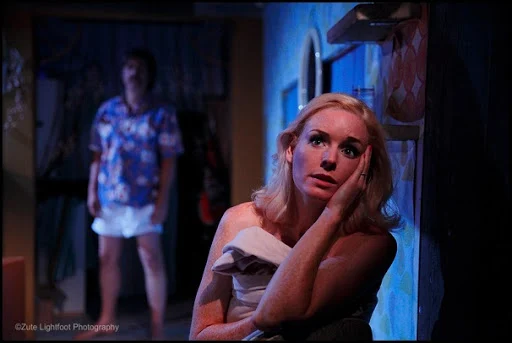
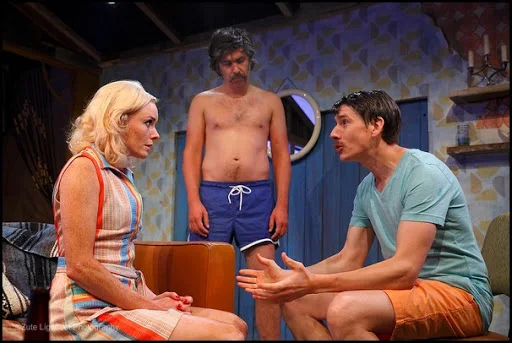
Directed by Hannah Price, The Dead Monkey is bleakly comic and very dark. It lures the audience in with a promise of humour and satire before savagely delivering its message. Written by Nick Darke in 1986 and originally performed by the RSC, The Dead Monkey is a tale of desperation and creeping violence in a grimy American marriage that is as relevant today as it was almost 30 years ago.
The Dead Monkey is expertly performed by a three-person cast consisting of James Lance as Hank, Ruth Gibson as Dolores and Charles Reston as the vet. With all the action taking place on the intimate Park 90 stage, the cast grips you from the very first scene and takes you on a rollercoaster ride of love and duplicity, desperation and euphoric recall.
I was especially impressed with the set design and costumes in the play. For a moment there, it really felt like we were in a beachside shack in California which made the final scenes ever more powerful. All three actors underwent incredible transformations in their appearance for their roles with Gibson chopping off her long red locks and dying them platinum blonde and James and Charles adopting a moustachioed, early 1980s look that was startling in its authenticity (or is it just me that finds that particular period of fashion unsettling?)
I thoroughly enjoyed The Dead Monkey and would highly recommend it.
This is the second time that I’ve seen a play at The Park Theatre in Finsbury Park and I have to say that I really like it. The theatre is in a great location and is situated right outside Finsbury Park tube station. There are also loads of great restaurants in the vicinity and I’d especially recommend Pasta Remoli and My Cottage Cafe Lebanese Restaurant on Clifton Terrace. I certainly hope to see more performances here in future.
Presented by London theatre company Mongrel Thumb, The Dead Monkey is showing at Park Theatre in Finsbury Park until 4 July 2015. Prices start from £18 each with £12.50 Tuesdays and Pay What You Can matinees. Book online at Park Theatre or by telephone on 020 7870 6876.
I've loved The Kinks for as long as I can remember, possibly all my life. They remind me of road trips with my Dad, singing along to “Sunny Afternoon” at the top of our lungs and serenading each other with “Days”. For the record, my Dad has a much better singing voice than I do but those are indeed days I’ll remember all my life.
The Kinks were there when I finished school, late nights at Bella Napoli in Johannesburg when revellers would flood the floor to dance to “Lola” and “You Really Got Me”.
I’m such a fan that when I was invited to see the new West End production of Sunny Afternoon, I said yes straight away without even checking to see if I was free that night. Nothing was going to keep me away.
Sunny Afternoon is as authentic as it gets and Ray Davies, lead singer of The Kinks, wrote the story in collaboration with playwright Joe Penhall. We learn how those first chords to “You Really Got Me” became one of the biggest chart anthems of all time and the influences behind Ray Davies' inspired lyrics. Through the music we learn how they were exploited by British music industry executives, how unions in America almost brought them down and how they made a legendary comeback in the summer of 1966.
The show is jam-packed with hits from The Kinks and features all of those mentioned so far as well as “Waterloo Sunset”, “Dedicated Follower of Fashion”, “I'm Not Like Everybody Else” and many more. Sunny Afternoon is obviously a must-see for fans of The Kinks but seeing the entire audience on their feet dancing by the end of the show made me realise this is a show for everyone.
John Dagleish is superb as the brooding and intense Ray Davies, lyrical genius and lead singer of the band. Dagleish managed to capture the boyish pitch of Ray's voice in his vocals and his performance was mesmerising, especially in his portrayal of Ray’s descent into depression.
George Maguire provided hilarious comic relief as Ray’s manic and irreverent younger brother Dave “The Rave” Davies. Just seventeen when “You Really Got me” was recorded, Dave went on to be voted one of Rolling Stone magazines 100 Greatest Guitarists of all time. Adam Sopp played drummer Mick Avory and Ned Derrington played the insecure bassist Pete Quaife who quite wrongly thought the band could survive without him.
I have long believed that I was born in the wrong era and have always loved 60s fashion so I especially appreciated the set design and costumes in Sunny Afternoon. If you’re a fan of 60s music and fashion, especially of the British Invasion, then you’re going to love this show.
Would I recommend Sunny Afternoon? Of course I would. It is really that good and I’d quite like to go see it again. Luckily they’ve extended bookings to May 2015 so I might just get a chance to do so.
Sunny Afternoon Harold Pinter Theatre, Panton Street, London SW1Y 4DN
I received a pair of complimentary tickets to this performance which just about made me the happiest blogger of all time. As is always the case, I promise to share sincere and honest opinions with my readers.
After a sold out run at the National Theatre, Richard Bean’s satirical play Great Britain moved to the Theatre Royal Haymarket this week and I got to attend one of the first performances. This anarchic and ridiculously funny play is not-so-loosely based on the phone hacking scandal and stars Lucy Punch as ambitious newspaper editor Paige Britain.
Great Britain follows Lucy’s exploits as she feeds her readers’ seemingly insatiable desire for dirt and gossip on celebrities and the royals. She beds whoever she needs to and will stop at nothing to increase her circulation. With the discovery that voicemails can be hacked, Lucy’s revelations ensure that The Free Press reaches stratospheric sales and yet the public keep coming back for more.
Great Britain is fast-paced with non-stop puns and allusions that had the audience in stitches. The set design is fantastic and I loved how they recreated both The Free Press offices and those of the Met Police. The show makes use of fictitious live news reports as well as viral videos of the events in the story and you can feel the mounting hysteria that were reminiscent of how events actually played out in the phone hacking scandal.
The play is funny – really funny – and we were just about weeping with laughter at times. I love that the script appealed to both Stephen and I as it is rare that we both enjoy a performance. I’m also renowned for having no sense of humour so it is an especially glowing recommendation if I find something this funny.
Lucy Punch is superb in her role as Paige Britain. There was a split second when the play opened that I recalled that this role belonged to Doctor Who alumni Billie Piper during the National Theatre run but those thoughts were immediately dispelled. This role was perfect for Lucy and she totally owned the role from the minute she sauntered onto the stage. Special mention must also go to Aaron Neil for his utterly convincing performance as the gormless Met Police Commissioner Sully Kassam and to Robert Glenister for his role as Paige’s editor Wilson Tikkel.
I would absolutely recommend this scathing satire of the press, police and politics in Britain. Great Britain runs at the Theatre Royal Haymarket for a strictly limited season until 10 January 2015.
Great Britain Theatre Royal Haymarket 18 Suffolk St London, SW1Y 4HT
I received a pair of complimentary tickets to this performance but to be honest, I would have most likely gone to see the play anyway. As is always the case, I promise to share sincere and honest opinions with my readers.
In my mind, I’ve always considered a divide between theatre and film. I’d never truly been moved by a show, never truly experienced the full range of emotions from elation to devastation and I was okay with that because that was the arena of film. That changed when I saw War Horse.
In a word, War Horse is spectacular. Based on the novel by Michael Morpurgo, War Horse has been brought to London’s New London Theatre by A Really Useful Group Theatre in association with South Africa’s Handspring Puppet Company.
I enjoyed every minute of the play and it really is the best West End show I have ever seen. Let me tell you a little bit more about the story, the actors, the set design and artwork and most of all, the puppets.
War Horse
War Horse is a delightful story but I obviously don’t want to give too much away. It is the story of how a young hunter is captured as a foal and sold at auction to the Narracotts, a farming family. Young Albert Narracott falls in love with the foal, names him Joey and works him until he earns his trust. All too soon, the First World War breaks out and the army calls for horses for the cavalry. Despite being separated, the bond between Albert and Joey ultimately proves to overcome the distance between them and the horrors of the war. This is a story about the futility of war and drawing lines, and the transcendence of love and hope.
The Cast
We were quite lucky on the evening we went to see War Horse because John Trindle was playing Albert Narracott (he usually plays Albert’s cousin, Billy). John did a really good job and he was absolutely endearing as the wide-eyed and optimistic Albert. I adored Rachel Sanders in her role as Rose Narracott, Albert’s mother. She was hilarious and made a great pair with Steve Nicolson who played Albert’s father, Ted.
My favourite actor was Richard Cant who played the conflicted German soldier Friedrich Müller. He gave a truly impeccable performance and managed somehow to win the sympathy of the audience despite being one of the enemy.
The Set and the Artwork
The War Horse set is quite simple but designer Rae Smith made use of exquisite artwork to convey the torn and devastated landscapes of war time France. Fragments of film, torn sketches from a notebook and other images were projected onto a screen and certainly made a dark and convincing backdrop for the play. When considered alongside the puppets, which I shall discuss next, it is no surprise that I found myself so emerged in the play.
The Puppets
I was impressed when I saw photos of the puppets before the show and after reading up about the Handspring Puppet Company, I knew we were in for a real treat. What I didn’t expect was to be so taken by these realistic and expressive puppets that I was moved to tears in the heart wrenching scenes towards the end of the play. I was so engrossed that I forgot for a moment that these were puppets, not real horses.
Hmmm. I don’t think I’ve quite conveyed the depth of my emotions there. Let’s just say there was a scene involving barbed wire that had me beating my chest and taking deep gulps of air, hoping against hope for an impossible outcome. It was agonising and in that moment, it did not feel like it was a mere puppet up there on the stage.
The puppets are life size and not only are we treated to both foals and full grown horses in the play, but there are also a fabulous goose, birds and crows. While the smaller animals require just one puppeteer, the horses require at least three people working behind the scenes but there were times when I barely noticed the puppeteers. These are not static puppets, that is for sure, and no detail is ignored. Ears flick in annoyance, the horse shifts weight from one back leg to the other while standing still, and they use their full momentum to rear up in anger.
War Horse is absolutely impressive in every way and I simply can’t fault it. I feel like I’ve been disappointed so many times in London theatres (I see a lot more than I review!) but this is one play that I would be happy to see again and again.
War Horse New London Theatre Drury Lane London WC2B 5PW
Blood Brothers is Willy Russell’s masterpiece and is currently in its twenty-third year at the Phoenix Theatre in London’s West End. It is a touching yet hilarious musical set in Liverpool from the early 50s to the late 70s. I had seen the play in Liverpool in 1996 and had always wanted to see it again. After a run of disappointing outings to West End musicals, I finally decided to head for a play that I knew wouldn’t disappoint me.
Opening with the line “So did y’hear the story of the Johnstone twins?”, Blood Brothers tells the tale of two brothers born of the same mother but separated at birth. Mrs Johnstone is a working class woman who has five children by the age of twenty-five. Destitute and abandoned by her husband, the pregnant Mrs Johnstone discovers that she is expecting twins and confides in her employer in a moment of desperation. The scheming (and barren) Mrs Lyons suggests to Mrs Johnstone that she doesn’t need two more mouths to feed and she convinces her servant to give up one of her babies. The deal is sealed when Mrs Lyons makes Mrs Johnstone swear on the Bible that she will uphold their deal.
All too soon after the birth, Mrs Johnstone realises her mistake but Mrs Lyons reminds her of her promise and takes one of the babies, leaving her with Mickey. Insecure and jealous of Mrs Johnstone, Mrs Lyons eventually terminates her employment in order to keep her away from ‘her’ baby Edward. She warns the suspicious Mrs Johnstone of an old wives tale (which she has conveniently fabricated) that if twins are ever separated, then they must never know of their sibling status, for if they ever discover the truth then both of them shall die on that very day.
Despite the intentions and scheming of the mothers, Mickey and Eddie meet at the age of seven and begin a friendship that will span the next twenty years.
Natasha Hamilton of girl band Atomic Kitten has landed the coveted role of Mrs Johnstone and this is her first theatre role. With her powerful voice and convincing 50s and 60s style, I had no idea that she was a theatre novice and thoroughly enjoyed her performance. Vivienne Carlyle played Mrs Lyons and Louise Clayton played Linda, the girl that starts off as Mickey’s best friend and ultimate comes between the brothers.
Special mention goes to Stephen Palfreman and Simon Willmont as Mickey and Eddie. My favourite part of the play is the first act where Mickey and Eddie meet as seven-year-olds and all the children of the neighbourhood play in the street. It is played out by the adult cast and was absolutely delightful in this performance.
My favourite actor in this performance was Philip Stewart as the narrator. As narrator he is the voice of fate, warning of the tragedy to come and Philip gave a chilling and powerful performance.
I could not fault this production of Blood Brothers and enjoyed each aspect of it. The stage design and props went a long way to representing the changing face of Liverpool in the 50s, 60s and 70s and the costumes were lovely. As a play, Blood Brothers captures the innocence and naivety of childhood as well as the silliness and the games children play. It is an uplifting and enjoyable play and I would absolutely recommend it.
Billed as “a truly terrifying theatrical experience”, Ghost Stories comes to the West End following a sell-out season at the Lyric Hammersmith. Ghost Stories is written by two men who need no introduction in the arena of the dark and macabre: The League of Gentlemen's Jeremy Dyson and Andy Nyman who is best known as co-creator and director of Derren Brown’s television and stage shows.
The play is narrated by Andy Nyman in his role as Professor Philip Goodman, an expert in parapsychology and a sceptic at heart. He begins by essentially debunking the idea of paranormal phenomena but then intriguingly introduces the idea that not everything is as it may seem. As he gives a mock lecture to the audience he explains that in twenty years of professional experience, he has come across only three cases that have been different enough to warrant his attention. These are the cases that disturb, that keep him up at night. I won’t spoil the play for you by telling you about the three cases but I can tell you there was a lot of screaming, squealing and hiding behind partners on the part of the audience. It is certainly not advisable to hold a drink in your hands whilst watching the show.
One of the best aspects of the show was the design. I had already noticed the dismembered leg in the foyer of the theatre and the main arena was transformed from a stately old theatre into a horror house of sorts. There was police tape and cob-webbed gas lamps to give a truly eerie experience and the overall effect was completed by the seemingly random numbers chalked onto the walls. The stage had a creepy veil as a curtain which had “safety curtain” painted on in red paint and green, slimy paint on the stage itself. The set design was really good too with distorted, angular rooms, creepy forests and corridors of old asylum cells to set the general tone of fear.
Ghost Stories is a lot of fun (if being scared and screaming out loud is your cup of tea) and I did enjoy the show. At times however, the plot did get a little ridiculous or thin and there were certainly times when the audience was laughing or scoffing when they should have been screaming. In a classic coup de théâtre, there is quite a twist at the end of the play and at first I felt a little bit underwhelmed by the ending. As I sat on the train on the way home though, I came to appreciate how cleverly all the pieces fit together as I sifted through the various clues that had been left throughout the play. Having said that, I didn’t feel that it was like watching a live horror film, as one audience member had previously stated and it certainly did not reach the levels of scariness and tension that films do. I can imagine that it is quite difficult to portray that nail-biting, terrifying suspense in front of a live audience and I had always been sceptical about the ability to bring such a story to the stage.
During the play, the one impression that I did have was surprise that they managed to secure a major West End theatre for the glorious summer and early autumn season as in spite of the impressive set design, this is really more of a community theatre production. Nevertheless, if you are looking for a fun and somewhat exhilarating 80 minutes, then I would recommend Ghost Stories. It is not the standard quality we’ve come to expect of West End shows though, so do make sure you’ve seen all of the big ones first.
Ghost Stories also stars Ryan Gage, David Cardy and Nicholas Burns and will run at the Duke of York’s Theatre until 7th November 2010. Tickets range from £22.50 to £47.50.
On Tuesday night, we went to see the Garrick Theatre production of Douglas Carter Beane’s The Little Dog Laughed.
The Little Dog Laughed is about a rising Hollywood star Mitchell (Rupert Friend) who in the words of his agent “suffers from a slight recurring case of homosexuality”. He meets rent boy Alex (Harry Lloyd) and their lives are turned somewhat upside down when they both fall for each other despite both asserting that they are not gay. The play is set against the backdrop of Hollywood and homosexuality and explores all of the double standards and difficulties with coming out in show business. There is a fantastic quote by Colin Firth in the programme which just about sums it up:
“If you’re a straight actor who takes on the role of a gay man, it’s obviously not the same as being one in this business”.
The Little Dog Laughed was written by Douglas Carter Beane who also wrote To Wong Foo, Thanks for Everything! Julie Newmar, a 1995 film starring Patrick Swayze and Wesley Snapes. It first opened off-Broadway at the Second Stage Theatre in 2006.
The play is narrated by Mitchell’s morally challenged agent Diane (played by Tamsin Greig) who has such classic lines as "A writer with the final cut? I'd rather give firearms to small children”. It is no secret really that I am a massive fan of Harry Lloyd and have spent the past three years watching each and every one of his plays but it is Greig who absolutely steals the show and her acting, wardrobe and personality all fit the role perfectly. In her role as Diane, Greig superbly breaks through the fourth wall, allowing the audience into the world of Hollywood agents, actors and writers and she did it very well indeed. She was incredibly comfortable chatting and winking to the audience one minute and then diving right back into her encounters with the rest of the cast the next.
Rupert Friend plays the drunken, privileged and somewhat sheltered Mitchell really well. While I tend not to question how characters were written (as it is generally a fixed factor when putting on a play), I have to wonder at a rising Hollywood star who doesn’t get the significance of coming out to the world and the effect that could have on his career. In the end, his naiveté is what trips him up though.
In an equal sense, Harry Lloyd’s Alex just doesn’t seem to understand the dynamic of his relationship with his girl pal Ellen (played by Gemma Arterton) and the effect that his growing relationship with Mitchell will have on her. He does, however, utter my favourite line of the play while trying to get a point across to Mitchell: “God, talking to you is like sewing a button on cottage cheese”.
As far as rather shallow, clueless roles go, Friend and Lloyd do as well as they can do but they have both taken on much better roles in the past. The one thing they do both handle extremely well is the intimacy and affection that develops between their two characters. There is a fair bit of nudity in the play (with Harry Lloyd being fully nude at one point) and both actors were professional and convincing in their roles.
Gemma Arterton was far less convincing and you got the idea that she was trying to inflate her supporting role somewhat as the character definitely shrinks in comparison to the other three. She seemed to posture a lot and to shout her lines rather than speak them with meaning and emotion. She is quite inexperienced in theatre though and this certainly didn’t ruin the play. You have to wonder though if those in casting didn’t foresee that she would be completely overshadowed by Greig (or perhaps that was the point?)
This production of The Little Dog Laughed was directed by Jamie Lloyd and I must say he made good use of the space and actors. There is one invisible character, so to speak, who appears in one scene and speaks on the phone but is not played by anyone. I thought this was really well portrayed by the cast and well managed by the director.
The set was designed by Soutra Gilmour who received an Olivier Award nomination for Best Set Design in 2009. While Gilmour’s sets are often dark and almost sinister, this was stark, bare and completely white but the minimalist set worked in this play.
The play itself is incredibly funny and highly entertaining. It doesn’t provide any grand answers to the problems it identifies but seems to focus more on the situation at hand and how that plays out. The audience was laughing along raucously at the numerous one-liners and there was much enthusiastic clapping and cheers of “bravo!” at the end.
All in all it was a fun night out and I’d certainly recommend the play for people seeking a light-hearted comedy experience.
The Little Dog Laughed is playing at the Garrick Theatre until 10 April 2010. There are really good prices available on tickets at LastMinute.com and we got tickets for £29.50 each from WestEndTheatre.com.
On the Bank Holiday Monday, Stephen took me to the Duke of York’s theatre to see A View from the Bridge. I was really excited to see this play as it was my birthday present and the main attraction was to see Harry Lloyd, a fine young actor who I am mad about (he played Will Scarlett in Robin Hood). Stephen is either very confident or very crazy as he absolutely supports the occasional crushes that I develop on film and television stars. It reminds me of the old Love Is… cartoon that said “Love Is… taking her to see Tom Jones”.
Harry Lloyd and Ken Stott in Arthur Miller’s A View from the Bridge [Image Source]
A View from the Bridge was written by Arthur Miller and premiered in its current two-act form in London in 1956. It is the story of an American family that takes in two Sicilian immigrants and the subsequent jealousy and betrayal as their young niece falls in love with one of the immigrants. Hayley Atwell starred as the niece, Catherine Carbone and her aunt and uncle were played by Mary Elizabeth Mastrantonio and Ken Stott respectively and Harry Lloyd played the role of Rodolpho (the object of Catherine’s affection).
I find it quite odd that so many of the reviews (for instance this one) critiqued the story itself and the nature of the play. To me, you can study a classic film or play and analyse the message that the writer or director was trying to convey or the use of various techniques. It seems strange to me to criticise that work though or pass judgement on it. The fact is that yes, the play was written during the aftermath of the McCarthy witch hunts in the US and that the story mirrors the themes of betrayal and victimisation that Miller was experiencing at that time. The above review criticised the use of the narrator which is crazy; it’s like reading Shakespeare and criticising his use of the soliloquy to convey his protagonist’s thoughts. It is a classic body of work and it’s not like the writer is going to read your review and do better next time – he is long dead! I am sure the academics and English students among my readers disagree though.
Hayley Atwell as Catherine and Ken Stott as Eddie [Image Source]
I really enjoyed this play and found it both funny and tragic. The set design was great and the costumes were quite authentic too. I had heard that there were a few problems in earlier performances with Ken Stott fudging his lines and a lack of cohesion in the cast. I am pleased to say that this was not the case in Monday’s performance. The acting was superb and the accents were good too; all in all it was a good theatre experience.
During the break, I saw the stunning Andrew Buchan from the show The Fixer in the audience. I know this is going to be hard to believe, but the man is even more beautiful in real life than he is on screen. I thought I was going to stop breathing when I saw him and Stephen was quite amused when he told me to stop staring (in my defence, my mouth may have been wide open but I was watching his reflection in a mirror and not staring directly at him). Anyway, I managed not to make a complete idiot of myself (as I did when I met The Parlotones) and I left the poor man alone. It was very exciting to be two metres away from two of my favourite actors though. A very happy birthday indeed!
We went to see the RSC production of Hamlet tonight at the Novello Theatre on Aldwych and I am sorry to say that we didn't like it at all. In fact, I did something I have never done before and that was leave during intermission. It's no secret that we originally bought tickets because David Tennant of Doctor Who fame was starring as Hamlet but after he sustained his prolapsed disc injury, I was more than willing to give the rest of the cast a chance. Tennant's understudy, Edward Bennett, took over in the role of Hamlet and I must say that he gave an energetic, enthusiastic performance. In the end though a couple of things several things ruined it for us: we could barely hear what the actors were saying (and we were in the stalls!); they really mixed up the order of the scenes and left out some vital scenes; they mixed Shakespearean English and modern English (and not in a good way); there was no set design and they wore 1950's costumes (?); and all in all it was a confusing mish-mash of a production. So we decided to escape early (if you can call it that - it was already two hours into the play!!).
In a way, I am glad that David Tennant wasn't able to perform tonight because I might have tried to stay for the full play or convince myself that I enjoyed it. Sadly, though, I really didn't. I think really hard-core Shakespeare fans might enjoy it as a modern, minimalist take on Hamlet (in the way that as a music lover, I appreciate a remix of a favourite track) but I do think you'd need to be really familiar with the story of Hamlet (or fluent in Shakespearean English) in order to have made sense of this production.
There have been rumours circulating that Harry Lloyd is to star in Arthur Miller's "A View From The Bridge" which is starting at London's Duke of Yorks Theatre in January. He is to be playing Rodolpho alongside Ken Stott and Mary Elizabeth Mastrantonio. One of the fans from HarryLloyd.net contacted his agent and she confirmed that Harry will indeed be playing this role.
This looks to be an all-star ensemble and I am not too sure if I am going to wait to get a group together. There are special group discounts but there are also early bird tickets of £39.50. Hmmm. But then you have to pay a £20 joining fee. Oh well... Still makes the tickets less expensive than the advertised £66. I can't make up my mind!
Most importantly, these tickets are going to sell fast and I don't want to be disappointed. I'm sure Stephen wouldn't mind me "treating" him to see this play for our wedding anniversary. It would be in line with this year's anniversary "treat" of seeing Harry in The Sea.